
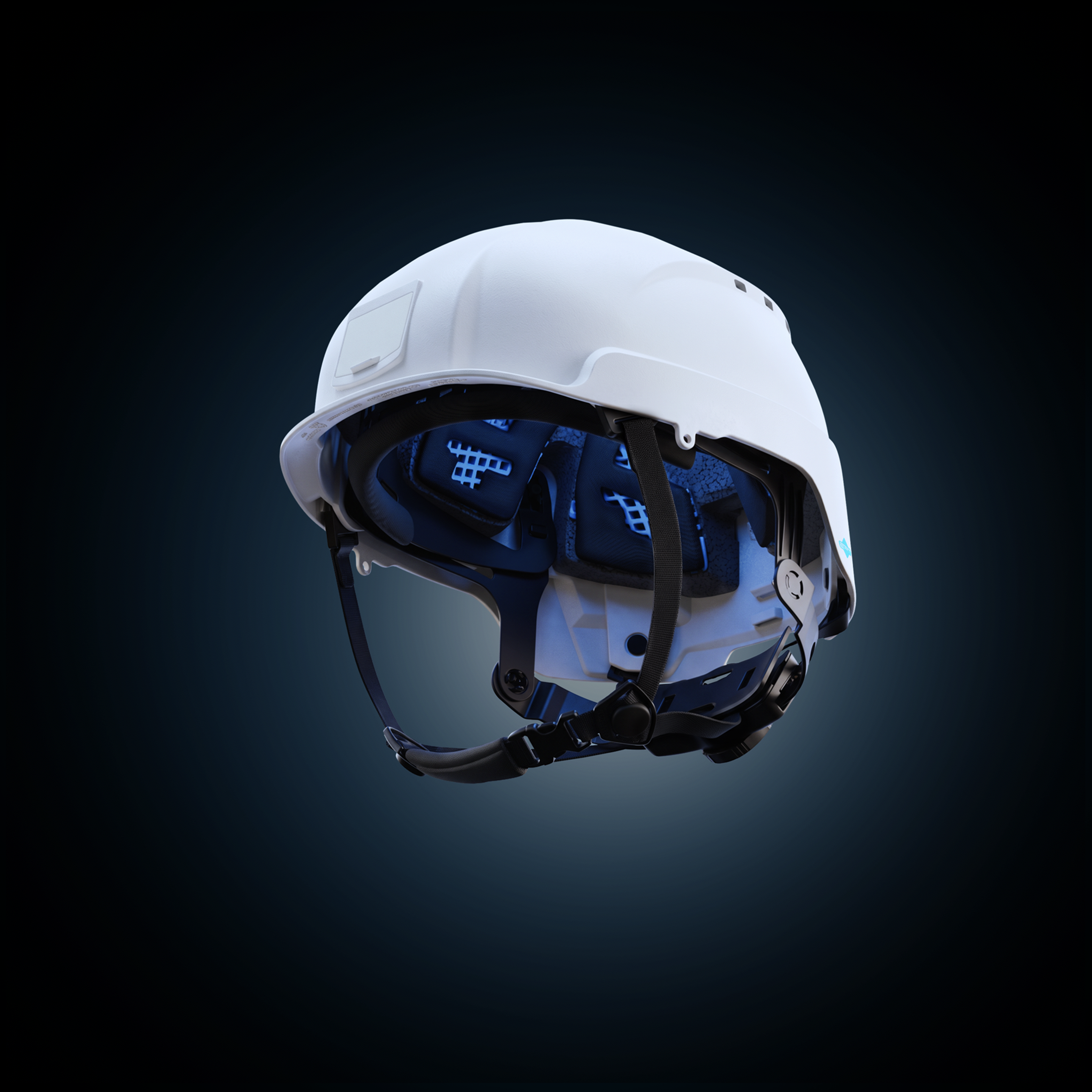
Quick answer: Energy Reduction Technology (ERT) is a layer of soft polymer pads between a helmet’s EPS liner and the comfort padding. It helps absorb energy from both direct and angled impacts. In independent comparative testing by SGS, MAXIMUS performed best of four helmets in two of the three impact tests. In an angled impact, the wearer’s head twisted the least. That matters because twisting is linked to brain injuries such as concussion. Against a hard edge, the head was jolted the least: 74 g, compared with 129 to 326 g for the other helmets. On a flat surface, MAXIMUS recorded the highest value of the four (156 g), but stayed well below the 250 g reference limit.
What is ERT (Energy Reduction Technology) in a safety helmet?
ERT (Energy Reduction Technology) is a patented impact-management technology. It uses soft polymer pads that compress, flex and shift on impact. This helps absorb both linear (direct) and rotational (angled) impact energy, so less force reaches the head.
While the technology is more commonly found outside the PPE world, in applications such as cycling, motorcycle and equestrian helmets, MAXIMUS brings this advanced impact-management technology to industrial head protection.
How ERT and the EPS liner work together
Most safety helmets rely on an EPS (expanded polystyrene) liner. This rigid foam crushes during an impact, absorbing energy before it reaches the head. EPS works well against hard, direct blows, but it needs a certain amount of force before it starts to compress.
In MAXIMUS, ERT sits between the EPS liner and the comfort padding. EPS remains the main impact-absorbing structure. ERT adds a second layer that responds immediately, even to lighter knocks, and helps manage the twisting from angled impacts.
For the wearer, this means the ERT pads start working sooner than EPS. They also respond to lighter knocks, like hitting your head on a beam or a low doorframe.
Supplier test: EPS alone vs EPS with ERT
To measure the benefits of ERT, our ERT supplier ran a controlled comparison. They took two of their helmet models and built each one in three versions:
-
with a standard EPS liner
-
with an EPS liner and ERT
-
with an EPS liner and a competitor’s impact-management technology
Both helmet models stayed the same within each comparison, so the differences came down to the technology added.
Our supplier measured two things:
-
Rotational acceleration (rad/s²): how strongly the head is twisted during an impact.
-
G-force: how hard the head is jolted in a straight line.
Each result is the average of all impacts in the test. The lower the value, the less force reaches the head.
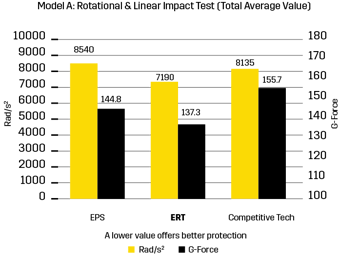
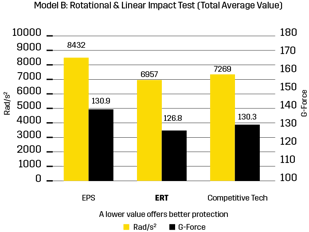
Chart 1: Rotational acceleration and g-force for EPS, ERT and competitor technology in two helmet models
Less rotation in an angled fall
In both helmet models, ERT recorded the lowest rotational acceleration and the lowest g-force of the three technologies.
With ERT added, less force reached the head. The head twisted less and was jolted less than with EPS alone or with the competitor technology.
Independent SGS test: MAXIMUS vs three competitor helmets
The supplier test isolates the effect of ERT. To see how the complete helmet performs, MAXIMUS was also tested by SGS, an independent laboratory, against three competitor helmets. The tests covered both rotational and linear impacts.
Note: This was comparative performance testing and should be distinguished from the certification testing required for MAXIMUS.
Angled impact test: MAXIMUS recorded the lowest rotational values
In a fall, the helmet often hits the surface at an angle rather than straight on. This makes the head rotate as well as take a direct blow. SGS tested this with an impact at 29 km/h onto an anvil angled at 45°.
Two measurements were recorded:
- PRA (Peak Rotational Acceleration): the maximum rotational acceleration recorded during impact.
- BrIC (Brain Injury Criterion): a measure based on how fast the head rotates during an impact. Higher values are associated with a greater risk of diffuse brain injury.
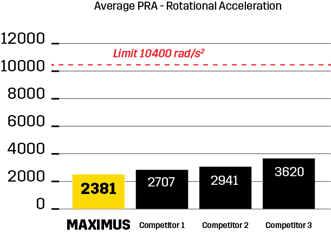
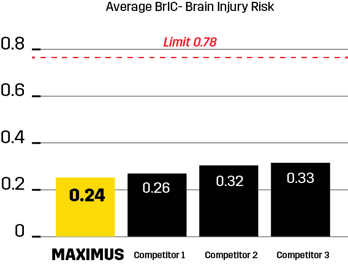
Chart 2: Peak rotational acceleration (PRA) and BrIC – MAXIMUS vs. three competitors
What does this mean for the wearer?
In a fall, a helmet often strikes the ground at an angle rather than straight on. This can make the head twist, and that twisting is linked to brain injuries such as concussion.
In this test, MAXIMUS recorded the lowest PRA and BrIC values of all four helmets. For the wearer, this points to better management of a type of impact that often happens in real falls.
Direct impact test: flat surface vs hard edge
SGS also tested linear impact performance. Peak g-force was measured after impacts onto two different surfaces:
- a flat anvil, representing an impact against a flat surface;
- a kerbstone anvil, representing a concentrated impact against an edge.
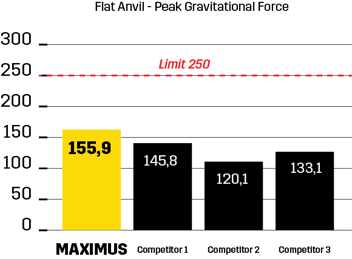
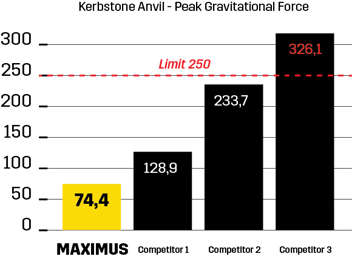
Chart 3: Peak g-force on flat anvil and kerbstone anvil – MAXIMUS vs. three competitors
What does this mean for the wearer?
In the flat-anvil test, MAXIMUS recorded 156 g. This was the highest of the four helmets, but well within the 250 g reference limit. The competitors recorded between 120 and 146 g.
In the kerbstone test, MAXIMUS recorded the lowest result of the four: 74 g, less than one-third of the 250 g reference limit. The competitors recorded between 129 and 326 g.
For the wearer, this means less impact force reaches the head in a collision with a hard edge, the kind of surface a professional could encounter in a real-world fall or accident.
FAQ
What is ERT in a safety helmet?
ERT stands for Energy Reduction Technology. It is a layer of soft polymer pads between the EPS liner and the comfort padding. The pads compress, flex and shift during an impact, helping to absorb energy and reduce how much the head twists.
Is ERT the same as MIPS?
No. Both help manage rotational forces, but they work differently. MIPS uses a low-friction layer that lets the helmet move slightly relative to the head. ERT uses soft polymer pads that compress, flex and shift to absorb energy from both direct and angled impacts.
Does ERT replace EPS foam?
No. ERT works alongside the EPS liner rather than replacing it. EPS remains the helmet's main impact-absorbing structure, while ERT provides an additional layer of impact management.
How did MAXIMUS perform in independent impact tests?
In independent comparative testing by SGS, MAXIMUS recorded the lowest PRA and BrIC values of four helmets in an angled impact test. In an impact against a hard edge, it recorded 74 g, compared with 129 to 326 g for the other helmets. On a flat surface, it recorded 156 g, the highest of the four but well below the 250 g reference limit.
Is MAXIMUS certified for industrial and climbing use?
Yes. MAXIMUS is certified to EN 397:2025 Type 2, which covers impacts to the top, front, sides and rear of the helmet and requires a secure chin strap. It is also certified to EN 12492:2025 for climbing and rescue.
The bottom line
ERT gives MAXIMUS an additional layer of impact management beyond EPS alone, helping manage both direct and rotational impact energy.
Independent laboratory testing of the complete helmet shows that MAXIMUS performed best of four helmets in angled impacts and impacts against a hard edge. On a flat surface, it recorded the highest value of the four, but stayed well within the reference limit.
For the wearer, that means stronger protection against angled hits and hard edges, two types of impact professionals can face in a real-world fall.
Selling PPE to professionals? Become a dealer and add MAXIMUS to your range.